

Product demo
A product demo from signup to pull request.
This product demo follows a GTM team’s growth question through Skene’s own workspace to the fix you review. Every screen shows real product output, including the five events Skene found missing in its own code.
Follow one question through the product.
Captured from the live app on 29 October 2026. Redrawn screens keep the app’s text.
One question, six steps Select a step to inspect
Start with your email. One source is enough.
A magic link signs you in, with no password or card. Connect GitHub or Supabase and the first analysis is free. A Supabase auth schema alone gives 11 events.
0 code events11 database events
| Event | Source | Found at | Status |
|---|---|---|---|
| email_ | Supabase | auth. | Can be tracked (DB) |
| email_ | Supabase | auth. | Can be tracked (DB) |
| email_ | Supabase | auth. | Can be tracked (DB) |
Ask the question in plain words.
The Agent page takes the question your GTM team brings you, not a query. Six teams each get a set of questions to start from.
- Can we tell whether acquisition events are tied to a known user or anonymous visitor?
- Can connected analytics sources support attribution by provider and source role?
- Do ingested analytics events carry the properties needed to identify an acquisition path?
Skene names what’s missing.
Asked how to raise retention, Skene took 14 investigation steps and named the five events the answer needs, with reasons. All five were missing from Skene’s own code.
14 investigation steps
To answer this question we need the following events:
| Event | Why | Parameters | Status |
|---|---|---|---|
first_ | This marks when an account reaches the product outcome, which is the key point to measure retention from. | plantimestamp | Not found |
feature_ | This shows which parts of the product customers keep returning to after activation. | featureplantimestamp | Not found |
onboarding_ | This identifies where customers stop during setup, which helps find early drop-off that hurts retention. | steptimestamp | Not found |
subscription_ | This captures churn directly so you can measure how retention changes over time. | plantimestamp | Not found |
support_ | This helps connect support issues to later churn or repeated use patterns. | timestamp | Not found |
Hand the fix to your coding agent.
How to fix turns the gap into a brief for a coding agent: where each call goes and what it sends.
Recommended fix
Add analytics calls for the smallest set of events required to answer the retention question, and include every required property exactly as listed:
first_value - Add in the setup or onboarding flow where an account reaches the product outcome.
- Send plan and timestamp.
feature_used - Add at the point of feature interaction.
- Send feature, plan, and timestamp.
Ask Skene from your editor.
Cursor connects with a workspace API key and one configuration block. Your agent then gets 11 Skene tools, including a tracking review before you push.
- Add the connection to your clientCursorManual setup
Merge into your Cursor MCP configuration.
Copy configuration{ "mcpServers": { "skene": { "url": "https://www.skene.ai/api/mcp", "headers": { "X-API-Key": "YOUR_WORKSPACE_API_KEY" } } } }Replace
YOUR_with your key before saving.WORKSPACE_ API_ KEY
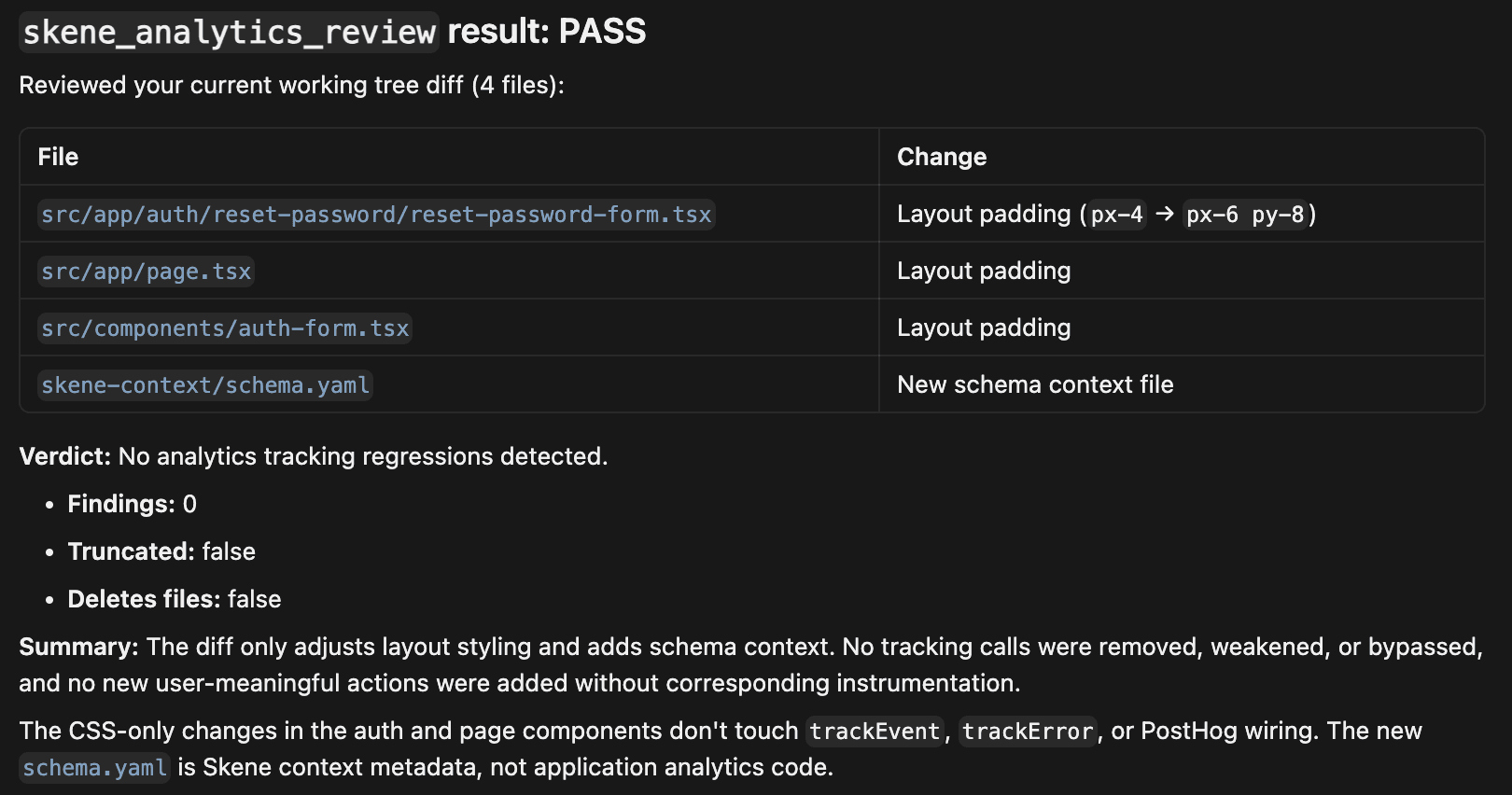
skene_analytics_review over MCP on a working-tree diff. Screenshot, cropped.Catch the break on the pull request.
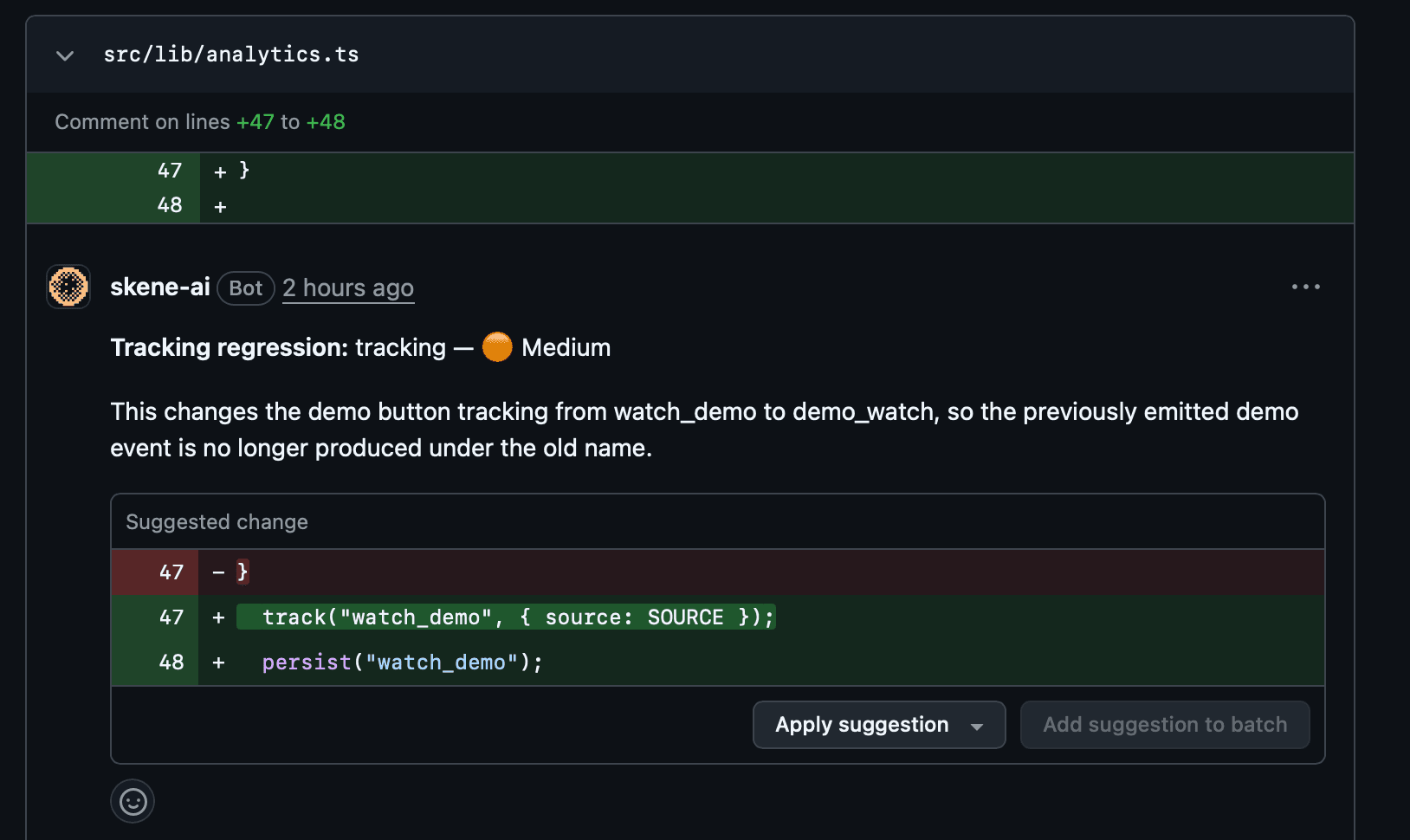
With PR reviews on, the Skene GitHub App checks every diff. Here it flags watch_demo renamed to demo_watch and suggests restoring the old name.
Start with the free audit.
Create a workspace and connect a source. One free audit per workspace, no card required.
Start free